10 EDFA Optical Amplifier Buying Tips?
Choosing an Edfa Optical Amplifier is not simply a matter of comparing gain figures. Network traffic keeps expanding, while fiber links demand tighter power control and cleaner optical performance. Cisco’s Annual Internet Report, covering 2017–2022, projected global IP traffic would reach 396 exabytes per month. That historical forecast still explains why operators require scalable amplification across backbone, data center, and access networks.
This guide presents 10 EDFA Optical Amplifier buying tips for practical evaluation. It examines gain range, noise figure, output saturation power, wavelength compatibility, connector options, monitoring, and thermal design. It also considers serviceability, warranty terms, and manufacturer testing evidence. The Cignal AI Optical Hardware Report consistently tracks strong demand for higher-capacity optical transport equipment, reflecting the pressure placed on amplification systems. TeleGeography’s Global Bandwidth Research Service likewise documents continuing growth in international bandwidth deployment.
A datasheet can still mislead. A high output-power number may hide poor noise performance, limited dynamic range, or difficult field maintenance. Buyers should request test results under realistic input levels, temperatures, and channel counts. Look for clear references to ITU-T recommendations, calibrated measurements, and documented alarm behavior. Small details matter. A loose connector, unstable fan, or unclear monitoring interface can delay restoration during a busy maintenance window. These 10 tips are not a substitute for network modeling. They provide a disciplined starting point, while recognizing that every fiber route has different loss, spacing, and reliability requirements.
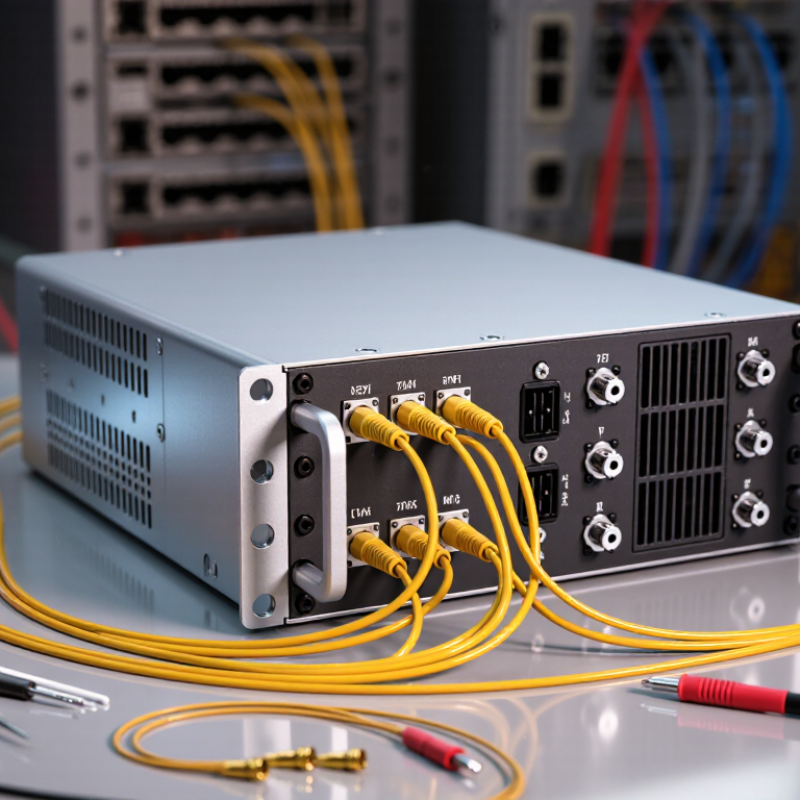
What Is an EDFA Optical Amplifier?
An EDFA optical amplifier is a fiber-based device that strengthens light signals without converting them into electrical signals. It uses erbium-doped fiber and pump lasers, usually at 980 or 1,480 nanometers. The amplifier works mainly across the C-band, from approximately 1,530 to 1,565 nanometers.
That range matters.
In dense wavelength-division multiplexing systems, one EDFA can amplify several channels together. It may serve as a booster after transmission, an inline amplifier across long spans, or a preamplifier before the receiver. Cisco’s Annual Internet Report forecast global IP traffic to reach 396 exabytes per month in 2022, compared with 122 exabytes in 2017. This growth explains why optical links need scalable amplification rather than repeated electrical regeneration.
When evaluating an EDFA, check gain, output power, noise figure, gain flatness, and saturation behavior. A high output rating is not automatically better. Excessive power can raise nonlinear penalties, especially in closely spaced DWDM channels. ITU-T G.694.1 specifies DWDM frequency grids, including 50 GHz and 100 GHz spacing, so channel compatibility deserves careful checking. Field experience also shows that connector loss, fiber aging, and temperature can reduce real performance. Datasheets rarely tell the whole story. A practical test should measure optical signal-to-noise ratio, gain stability, and alarm response under the intended span conditions.
Define Your Network’s Power and Wavelength Requirements
Before buying an EDFA, map the network’s actual power budget and wavelength plan. ITU-T G.694.1 defines DWDM channel spacing, including 100 GHz grids near the C-band. The conventional C-band spans about 1530–1565 nm, while L-band systems extend beyond it. Confirm the transceiver wavelengths, channel spacing, and fiber type before selecting an amplifier.
Measure every span, not only the headline distance. Record fiber loss, connector loss, splice loss, and planned engineering margin. A 0.2 dB connector penalty can become significant across many sites. Typical commercial EDFAs may offer roughly 17–23 dBm output, but higher power does not always improve performance. Excessive launch power can increase nonlinear effects, especially in dense DWDM links. Check gain flatness, noise figure, saturation behavior, and input power range. ITU-T G.698.2 also highlights the importance of multichannel interoperability and optical power control in amplified systems.
I would leave at least 3 dB of practical margin after calculating span loss. That is not universal. Field conditions change. Temperature, aging, and added channels can shift the result. Use an optical spectrum analyzer to verify channel power and OSNR during commissioning. Recent optical-network capacity reports from Cignal AI describe continued growth in 400G and higher-rate deployments, making wavelength discipline more important. A cheaper EDFA may pass today’s test, yet fail after future channels are activated. Specify power per channel, total output power, wavelength range, and monitoring functions in writing.
Compare EDFA Performance Specifications and Features
Compare EDFA Performance Specifications and Features
When comparing an EDFA, begin with gain, output power, and noise figure. These values affect link reach, receiver margin, and signal quality. A 20 dB gain rating may look impressive, but it means little without input-power conditions. Check whether the specification applies across the full operating wavelength range.
Look closely at gain flatness and output-power stability. Uneven gain can weaken some channels in a dense wavelength system. A practical comparison should include saturation behavior, not only maximum output. Ask for test data at different input levels. Connector type, optical return loss, and polarization-dependent loss also deserve attention. Small details matter during installation.
Control features can reduce maintenance time. Automatic gain control helps maintain stable performance when channels change. Automatic power control can protect sensitive equipment from sudden output variations. Remote monitoring, temperature alarms, and pump-current records provide useful evidence during troubleshooting. Verify the monitoring accuracy, because a displayed value is not always a measured value.
Environmental specifications need careful reading. Confirm operating temperature, humidity limits, cooling method, and power requirements. In field installations, airflow restrictions may reduce real output. Laboratory figures may not match a crowded rack. I have seen good-looking specifications fail after connector contamination or poor power budgeting. That possibility should influence the final purchase decision.
Assess Supplier Quality, Total Cost, and Technical Support
Buying an EDFA starts with supplier quality, not the lowest quotation. Check factory records, calibration certificates, burn-in procedures, and traceable test results. The ISO Survey 2023 recorded over 1.2 million ISO 9001 certificates worldwide, but certification alone proves little. Ask for recent audit findings. Request sample-based evidence.
Evaluate gain flatness, noise figure, output power, return loss, connector quality, and alarm behavior across operating temperatures. Require test data at your actual wavelength range and input power. A reliable supplier should explain measurement uncertainty. That detail matters. Also verify compliance with IEC 60825-1 and relevant telecom standards. Do not accept copied graphs without serial-number records.
Total cost includes power, cooling, spares, commissioning, software access, shipping, and field labor. The Uptime Institute’s 2024 Global Data Center Survey continues to identify outages as a major operational concern, making recovery support part of the purchase price. Compare five-year ownership costs, not only unit prices. Ask for mean time to repair, replacement timelines, remote diagnostics, and escalation contacts. A 24-hour response promise may still fail without local engineers or spare units. Test the support process before signing. Send a technical question and measure the answer quality. I would also challenge vague warranty exclusions. Some suppliers publish impressive specifications, yet provide limited assistance after delivery. That gap deserves a written service-level agreement.
10 EDFA Optical Amplifier Buying Tips: Quality, Total Cost & Technical Support
Use these measurable checkpoints when comparing EDFA suppliers. Typical values shown are common telecom procurement reference ranges and should be confirmed against the required application.
A suitable EDFA should combine adequate optical gain and output power with a low noise figure, stable operation across the required temperature range, reliable monitoring, clear warranty terms, documented test results, predictable delivery, and responsive technical support. Evaluate total cost over the equipment lifecycle rather than purchase price alone.