China Top 10 Rotomolding Machine Manufacturers Guide
China’s rotomolding industry has grown from small workshops into a competitive manufacturing network. Today, many suppliers offer complete Rotomolding Machines for tanks, toys, containers, kayaks, and industrial parts. However, choosing a reliable manufacturer requires more than comparing catalog prices.
This guide introduces ten leading Chinese manufacturers through practical and technical considerations. We examine machine design, heating control, cooling performance, mold compatibility, automation, and production capacity. Details matter. A stable oven temperature can protect wall thickness. A responsive PLC can reduce cycle errors. Strong steel frames can limit vibration during rotation. These features often influence long-term operating costs more than the initial quotation.
Factory experience also matters. We consider export records, customer references, quality systems, installation support, spare-parts availability, and operator training. Where possible, buyers should request production videos, layout drawings, test reports, and a live machine demonstration. Claims should be checked carefully.
No list is perfect.
Manufacturers change. Specifications may vary. Some public information remains incomplete, especially for customized equipment. Therefore, this guide should support careful comparison rather than replace technical due diligence. Buyers should confirm power requirements, mold dimensions, cycle times, safety controls, and local service arrangements before signing a contract.
The following overview aims to provide a balanced starting point for global purchasers. It combines observable product information with practical purchasing experience. Some rankings may invite debate, and that is reasonable. A machine that suits a large automotive supplier may not suit a small rotational molding workshop. The best choice depends on material, output, budget, and production goals.
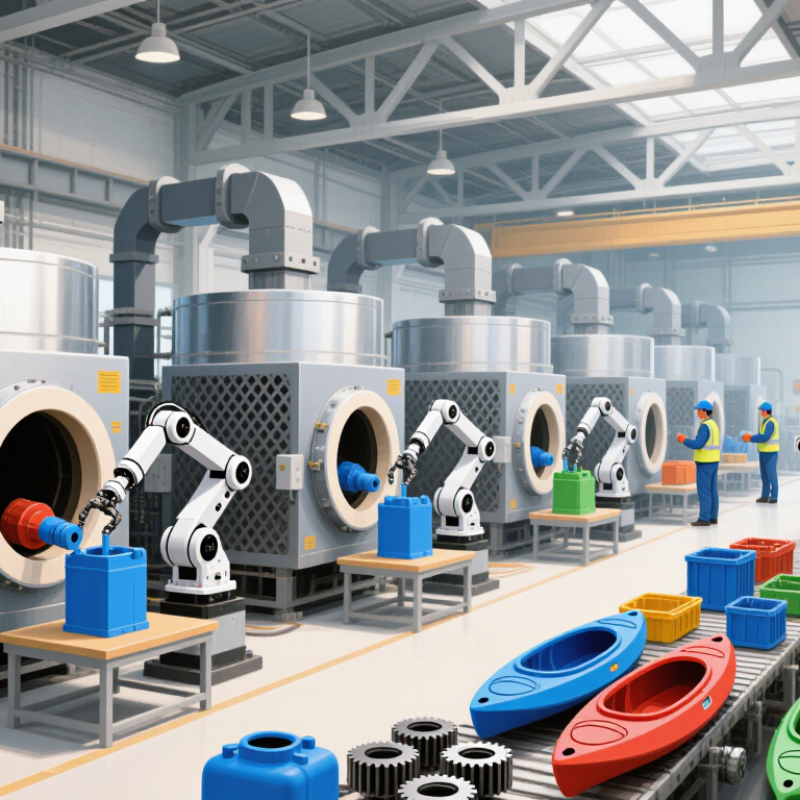
Rotomolding Technology and Its Role in Modern Manufacturing
China Top 10 Rotomolding Machine Manufacturers Guide
Rotomolding Technology and Its Role in Modern Manufacturing
Rotomolding creates hollow plastic parts through heating, rotation, and controlled cooling. A steel mold turns slowly inside an oven. Powdered resin coats the inner surface evenly.
Fortune Business Insights estimated the global rotational molding market at about USD 5.4 billion in 2023. Its forecast suggests steady growth through 2032, supported by water tanks, automotive components, agricultural containers, and recreational products. The process uses low internal pressure. Therefore, tooling usually costs less than injection molding. Complex shapes are also practical.
But the process is not automatically efficient. A typical cycle may require long heating and cooling periods. Energy use can rise when ovens lack insulation or temperature control. Wall thickness may vary near corners, handles, and deep recesses. I have seen a visually smooth tank fail testing because its base cooled unevenly. Small details matter.
When comparing Chinese machine manufacturers, buyers should inspect oven temperature uniformity, arm balance, mold-change time, and data logging. The Plastics Industry Association’s 2023 industry data shows plastics manufacturing remains a major industrial activity in the United States, but broad production figures do not measure rotomolding efficiency directly. That limitation deserves attention. A machine’s advertised capacity may not reflect real output with thick-walled products, recycled content, or frequent mold changes. Trial production, energy records, and independent quality checks provide stronger evidence than brochures.
Key Criteria for Evaluating Chinese Rotomolding Machine Manufacturers
China Top 10 Rotomolding Machine Manufacturers Guide
Evaluating Chinese rotomolding manufacturers requires more than comparing quotations. Grand View Research and Mordor Intelligence reports project steady global rotational molding growth through 2030, generally at mid-single-digit annual rates. This growth increases pressure on suppliers to deliver stable output, not just attractive prices. Ask for machine records showing cycle time, oven temperature stability, arm movement accuracy, and scrap rates. A factory should provide traceable test data from comparable molds.
Energy use deserves careful attention. Rotational molding depends heavily on heating and cooling efficiency. Request kilowatt-hour data per cycle, measured under defined load conditions. Control systems should record temperature curves and alarm events. Safety documentation, electrical conformity, and ISO 9001 quality procedures also matter. These documents do not guarantee excellent machines, but missing records deserve scrutiny.
Service capability often separates reliable equipment from expensive downtime. Check spare-parts lists, remote diagnostic response times, installation procedures, and technician training records. Ask to inspect a running machine, not only polished photographs. The Plastics Industry Association’s industry reports repeatedly highlight labor, operating costs, and supply-chain pressure as major manufacturing concerns. Therefore, software usability and maintenance access should be evaluated beside mechanical strength. A cheaper machine may consume more energy or require longer repairs. No checklist is perfect. Some buyers, including experienced ones, still overvalue initial price and underestimate commissioning support.
China’s Top 10 Rotomolding Machine Manufacturers by Core Strengths
China Top 10 Rotomolding Machine Manufacturers Guide
China’s top ten rotomolding machine manufacturers differ by core strength, not factory size alone. One may excel in shuttle machines, while another focuses on carousel systems, automation, or energy control. Their strongest suppliers usually provide mold design, temperature testing, installation, and after-sales training. Grand View Research reported continued growth in the global rotational molding market, supported by demand for large, durable plastic products. China’s National Bureau of Statistics recorded about 74.9 million tonnes of plastic product output in 2023. That scale creates useful manufacturing experience, but it does not guarantee equal machine quality.
A practical comparison should examine heating uniformity, arm balance, cycle repeatability, and control-system accuracy. Manufacturers with strong engineering teams often offer custom layouts for tanks, pallets, playground parts, and insulated containers. Others compete through shorter delivery times or lower operating costs. Energy use deserves close attention. A cheaper machine can become expensive when ovens lose heat or burners require frequent maintenance. The evidence is not perfect; published efficiency claims often lack independent testing. Buyers should request factory trial data, service records, and references from similar production lines.
Tips: Ask for a complete cycle video, not only product photos. Check mold change time and spare-part availability. Require documented temperature curves. Compare total ownership cost over five years, not the purchase price alone. A local inspection can reveal details that brochures miss.
Machine Types, Applications, and Industry Compatibility
China Top 10 Rotomolding Machine Manufacturers Guide should focus on machine fit, not ranking alone. A credible comparison covers shuttle, carousel, clamshell, and rock-and-roll systems. Shuttle machines suit medium batches and large tanks. Carousel systems support continuous production with several stations. Clamshell models work well for compact parts and limited floor space. Rock-and-roll machines handle long products, such as kayaks and pipes.
Applications determine compatibility. Automotive suppliers need stable wall thickness and repeatable heating. Water-storage manufacturers often prioritize large molds, cooling control, and structural strength. Consumer-product factories may value quick mold changes and flexible batch sizes. PlasticsEurope reported 413.8 million tonnes of global plastics production in 2023. Grand View Research also valued the rotational molding market above USD 5 billion in 2023, with continued growth expected. These figures suggest opportunity, but they do not prove every machine fits every plant.
Tips: Check mold diameter, oven capacity, heating method, cooling accuracy, and power consumption. Ask for cycle-time records from similar materials. A machine rated for large products may waste energy on small parts. That assumption fails. I would also inspect control-system usability, maintenance access, and operator training. A lower purchase price can hide costly downtime. The “top 10” ranking should remain flexible, because local service quality and factory experience can change the final choice.
China Top 10 Rotomolding Machine Manufacturers Guide: Machine Types, Applications, and Industry Compatibility
Indicative compatibility scores from 1 to 5, based on typical rotomolding process characteristics, production flexibility, mold size, and common end-use requirements. The data does not represent any company or brand.
How to read the chart: Carousel machines are well suited to high-volume, multi-arm production; shuttle machines support large parts and flexible batch manufacturing; clamshell machines are commonly used for compact or medium-sized products; rock-and-roll machines fit long, narrow parts; and vertical machines are suitable for space-efficient production of smaller components.
Purchasing Considerations, Quality Standards, and After-Sales Support
Buying a rotomolding machine requires more than comparing heating capacity and quoted prices. Plastics Europe reported 400.3 million tonnes of global plastics production in 2022, increasing pressure on manufacturers to control waste and energy use. Ask suppliers for measured cycle data, power consumption, temperature uniformity, and scrap rates from similar molds. A factory visit can reveal details brochures hide, such as uneven oven insulation or difficult mold loading.
Quality systems deserve careful checking. The ISO Survey 2022 recorded 1,265,216 ISO 9001 certificates worldwide, yet certification alone does not prove stable machine performance. Request calibration records, weld inspection results, control-system documentation, and a factory acceptance test using your actual process settings. Check whether safety circuits, guarding, emergency stops, and electrical documentation meet the destination market’s requirements. Independent inspection is sensible.
After-sales support often decides the real cost. Confirm response times, spare-parts availability, remote diagnostics, technician training, and software backup procedures. A useful contract should define uptime targets and escalation steps. Keep critical parts locally when possible. Even strong suppliers may underestimate commissioning time. That is worth questioning. A practical trial should run several production cycles, including start-up, shutdown, alarm recovery, and mold changes, before final acceptance. Data should be recorded, not remembered.