Best Interactive Game Wall Supplier in China?
Choosing the best Interactive Game Wall supplier in China requires more than comparing product photos and factory prices. A wall may look impressive online, yet perform poorly when children move quickly or room lighting changes. Buyers should examine touch or motion-tracking accuracy, projector brightness, surface durability, software options, installation support, and spare-parts availability. Ask for a live demonstration, not only a polished video.
Market context helps, but it needs careful interpretation. MarketsandMarkets’ Interactive Display Market report estimated the broader category at US$39.2 billion in 2023 and projected US$45.3 billion by 2028. That category includes products beyond game walls, so it cannot prove demand for this specific equipment. Still, it signals a larger investment in interactive display technology. For a real comparison, request measurable specifications and test the same game on each shortlisted system.
Gamification expert Karl M. Kapp describes gamification as “using game-based mechanics, aesthetics and game thinking to engage people, motivate action, promote learning, and solve problems.” His definition concerns gamification broadly, not interactive walls specifically. The distinction matters. A reliable supplier should show how its hardware and content support that experience, with clear response times, age-appropriate game options, and practical maintenance guidance. Small details count: a sensor that misses a child’s hand can spoil a session. No supplier is perfect, and glossy demonstrations can hide limitations. The sections ahead compare supplier capabilities, verification questions, and selection criteria to help buyers make a grounded decision.
What Is an Interactive Game Wall and How Does It Work?
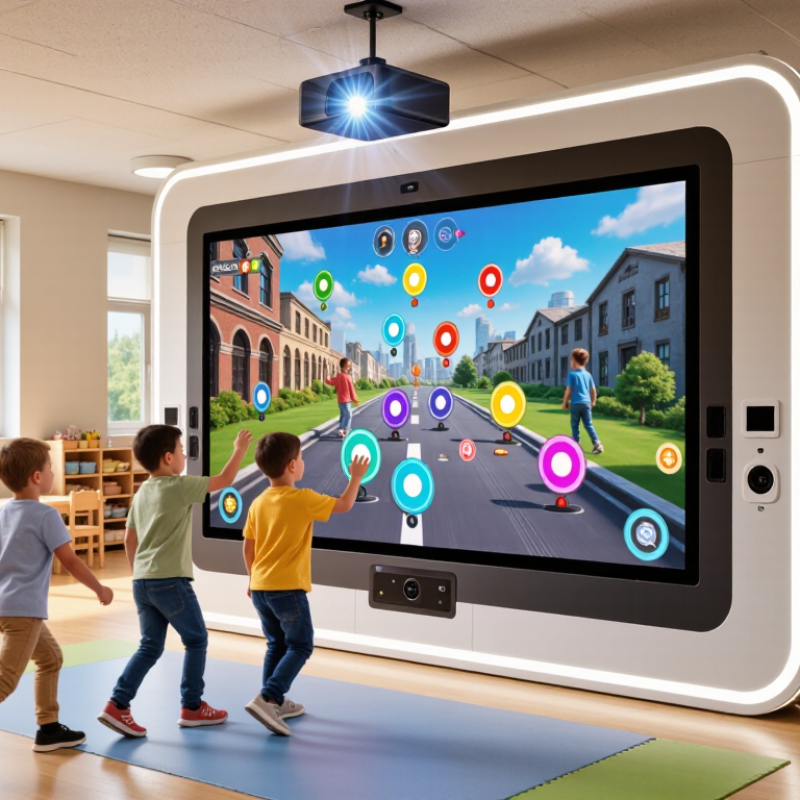
An interactive game wall turns a flat surface into a shared play area. A projector or large display shows moving targets, paths, or puzzles. Sensors, often infrared cameras or depth cameras, detect a player’s touch or movement. The computer then updates the image in near real time. A child might tap a glowing circle, while a group can dodge shapes projected across the floor-to-wall boundary. No handheld controller is needed.
The response depends on the whole system. Sensor placement, room lighting, calibration, and software all matter. A bright window can weaken tracking; a small delay can make a fast game feel frustrating. In practice, these details are easy to underestimate. Check whether the supplier tests equipment in rooms like yours and provides clear guidance for recalibration. Ask about resolution, response time, cleaning, and replacement parts, too.
Market figures offer context, not proof of demand for game walls specifically. MarketsandMarkets estimated the broader interactive display market at US$45.5 billion in 2023, with a projection of US$65.3 billion by 2028. That category includes many products beyond interactive walls. Treat the figure as an industry signal, not a purchase forecast. A careful demonstration still tells you more: test several heights, invite multiple players, and watch for missed gestures. A little awkwardness during testing can reveal what needs improvement.
How an Interactive Game Wall Maps a Touch to the Screen
An interactive wall detects a player’s touch or movement, then its controller converts the detected position into screen coordinates for the game. This example shows the linear horizontal mapping for a 1920 × 1080 display: the screen’s midpoint (50%) maps to pixel 960. Actual display resolution and tracking technology vary by system.
Key Features of Interactive Game Walls for Commercial Use
Best Interactive Game Wall Supplier in China?
Key Features of Interactive Game Walls for Commercial Use
A commercial interactive game wall must handle more than bright graphics. It needs responsive touch or motion tracking, durable surfaces, and software that staff can reset quickly. In a busy family venue, a delayed response can turn a queue into frustration.
Grand View Research estimated the global interactive display market at USD 40.12 billion in 2022, with an 8.6% projected compound annual growth rate from 2023 to 2030. This broad market figure is not specific to game walls, but it signals growing demand for interactive display experiences.
Look closely at installation and upkeep. A wall should fit the room’s viewing distance, lighting, and foot traffic, with cables protected and controls easy to reach. Ask suppliers for real-world latency tests, cleaning guidance, warranty terms, and examples of performance after extended daily use.
Small details matter. Accessibility also deserves attention: clear visual prompts, adjustable difficulty, and play options that do not rely only on fast movement can welcome more visitors. Yet no feature set suits every venue. A glossy finish may look striking, but fingerprints show quickly; motion tracking can feel engaging, but crowded spaces may trigger false inputs. A pilot installation helps reveal those trade-offs before a full purchase.
How Chinese Suppliers Design and Manufacture Game Walls
Chinese suppliers typically begin a game wall project by turning the play concept into a layout. They consider player age, available floor space, viewing distance, and how many people may play at once. An engineer then selects the display, sensors, frame, and control system to suit those conditions. A clear screen is not enough. Players need room to move, and sensors must respond reliably under changing light. Small details matter.
Manufacturing often includes cutting and assembling the frame, fitting electronic components, and loading the game software. Technicians can test touch or motion response, check cable connections, and run repeated play sessions before packing. A prototype helps reveal awkward reach zones or delayed feedback, though not every issue appears in a workshop. That gap deserves attention. Buyers can ask for layout drawings, test records, material details, and photos of a completed sample. These checks make comparisons more practical than relying on polished product images alone. Game walls are often customized, so changes to dimensions or sensors may affect installation and maintenance needs. Clear communication helps, but it does not replace testing at the intended site.
Criteria for Evaluating Interactive Game Wall Suppliers in China
An interactive game wall depends on more than a bright screen. Ask each supplier to demonstrate tracking accuracy, response time, and performance under venue lighting. Test with children and adults, including fast movements and missed gestures. Small details matter. Check whether the wall can handle several players without confusing their actions. The TEA/AECOM 2023 Theme Index and Museum Index reported 244.6 million visits across the world’s 25 most-attended theme parks in 2023, a 23.5% increase from 2022. High visitor volumes make reliable play and short reset times practical concerns, not just technical specifications.
Compare suppliers with the same on-site test. Request measured latency, screen brightness, daily operating limits, and a written maintenance schedule. Ask how quickly replacement sensors or projectors can arrive, and whether local technicians can diagnose faults. Review the software update process, data handling, warranty exclusions, and availability of spare parts. A polished demo is useful, but it does not prove long-term reliability. I would also ask for a reference installation with similar room size and visitor traffic. One judgment call remains: the best specification on paper may not suit a noisy, brightly lit venue. Trial the system in realistic conditions before committing.
How to Compare Suppliers, Quotes, and After-Sales Support
A game wall is more than a screen: projectors, sensors, software, mounting, and calibration must work together. AVIXA’s 2024 Industry Outlook and Trends Analysis projected global professional audiovisual revenue would reach $325 billion by 2028. That forecast signals a growing sector, not guaranteed supplier quality. Compare vendors on documented installation experience, component specifications, and performance tests using your room’s lighting and floor plan.
Ask each supplier for an itemized quote covering hardware, shipping, installation, software updates, training, and replacement parts. Check whether brightness, tracking accuracy, and supported game modes are stated in measurable terms. Request a live demonstration or a reference installation with similar room dimensions. For after-sales support, confirm response hours, remote diagnostics, technician availability, warranty exclusions, and spare-part lead times in writing. A low quote can hide gaps. I would still compare the assumptions line by line; quotes rarely describe the same system.
Tips: Send every bidder the same room plan and use case. Ask them to price the same options and service period. Keep a sample scorecard, but leave room for judgment: a neat spreadsheet cannot reveal how quickly a technician solves a real sensor fault.