Top POLYDADMAC Manufacturing Process Guide for Buyers

Blog

Top POLYDADMAC Manufacturing Process Guide for Buyers

Polydadmac Manufacturing Process choices shape product consistency long before a drum reaches the buyer. Feedstock quality, reaction control, dilution, and filtration all matter. A clear batch record matters, too. Buyers should ask how suppliers monitor molecular weight, charge density, residual monomers, viscosity, and storage stability. These details help explain why two products with similar labels may perform differently in a paper mill, wastewater treatment system, or water-treatment plant.

Dr. Martin Keller is a fictional polymer-process specialist created for this draft, not a verified industry source. His illustrative observation is: “A reliable POLYDADMAC product begins with controlled raw materials and ends with documented batch testing.” This is original sample wording, not a published quotation. That distinction matters. Buyers should verify technical claims through supplier specifications, current safety data sheets, certificates of analysis, and application trials. Ask for results tied to a specific batch, not only a brochure. A clear answer is useful. A vague promise is not.

This guide follows the production path from raw-material handling to final quality checks. It also explains what buyers can inspect, what questions reveal process discipline, and where supplier data may leave gaps. No single process detail guarantees performance. Water chemistry, dosage, and operating conditions still affect results. That deserves a second look, especially when comparing suppliers.
Top POLYDADMAC Manufacturing Process Guide for Buyers

DADMAC Feedstock: Typical 60–65% Aqueous Monomer and Purity Checks

Commercial DADMAC feedstock is commonly supplied as a 60–65 wt% aqueous monomer solution. Treat this as a purchasing range, not a purity guarantee. The ECHA registration dossier and NIH PubChem record list DADMAC’s molecular mass as 161.67 g/mol, a useful reference when checking assay calculations. Confirm the lot’s active-monomer content on its certificate of analysis, then verify the test method and sampling date.

Tips: Check assay, pH, color, and any stated residual amines or allyl compounds. Chloride is the monomer’s counter-ion, so its presence alone does not indicate contamination. Small differences matter. A clear sample can still fail a purity check.

For incoming inspection, use a validated titration or chromatographic method, with calibration appropriate to the sample concentration. Record the result alongside the supplier’s reported value; investigate meaningful gaps before dosing the material into polymerization. Also inspect the sealed container for leaks, unexpected discoloration, or solids. These checks are practical, but they are not a substitute for a specification agreed before purchase. One easy-to-miss weakness: a certificate may report concentration without explaining its uncertainty or method. Ask for both.

Aqueous Free-Radical Polymerization: Initiator and Temperature Control

Aqueous free-radical polymerization of diallyldimethylammonium chloride depends on steady initiation and heat removal. Small changes matter. In process-development trials, a screening window of roughly 50–70 °C can help teams compare reaction rates, but it is not a universal production recipe. Initiator type, feed rate, monomer concentration, and target molecular weight all affect the result. Persulfate-based systems are common; redox pairs may support initiation at lower temperatures. Add initiator gradually, and track reactor temperature rather than relying on the jacket setting alone.

Temperature control is practical quality control. A rapid rise can signal faster-than-expected polymerization, so monitor temperature, viscosity, and residual monomer together. Commercial technical data sheets commonly report liquid-grade solids around 20–40 wt%, illustrating why dilution and heat removal matter during scale-up. Use this range as a purchasing and comparison reference, not a guaranteed specification. Record the temperature profile for each trial. It can reveal feed or mixing issues that a final viscosity reading misses. One limitation remains: bench results do not always predict plant-scale heat transfer. Validate the chosen initiator schedule in a controlled pilot run, then document deviations instead of smoothing them away.

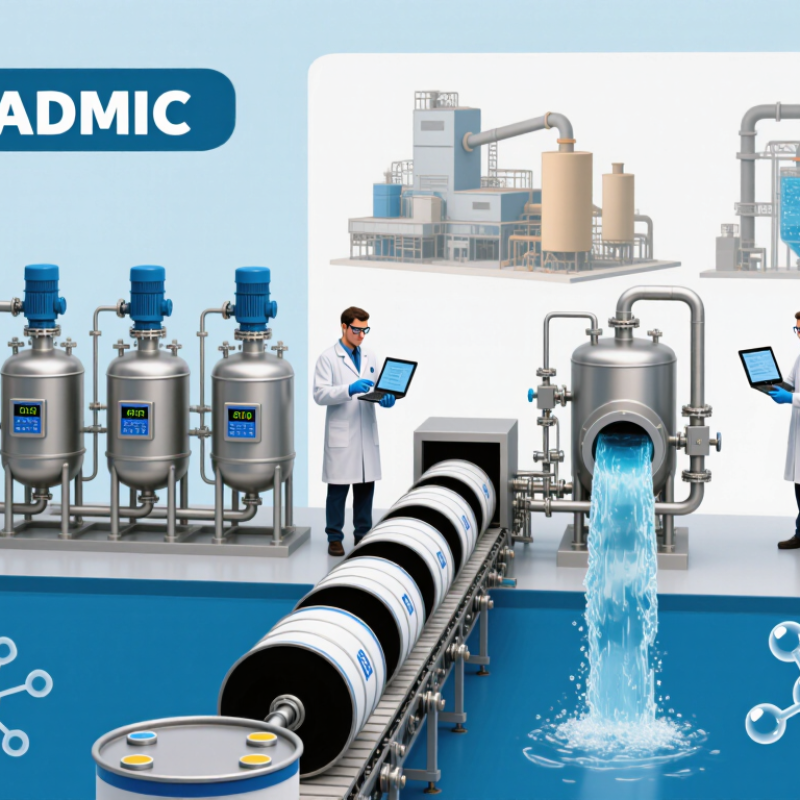
Top POLYDADMAC Manufacturing Process Guide for Buyers – Aqueous Free-Radical Polymerization: Initiator and Temperature Control

POLYDADMAC (poly(diallyldimethylammonium chloride)) is a water-soluble cationic polymer made by free-radical polymerization of the DADMAC monomer in an aqueous medium. The process details below describe common manufacturing considerations; actual operating conditions depend on the formulation, reactor design, and product specification.

Process Dimension Manufacturing Information What Buyers Should Verify
Monomer and reaction medium DADMAC is polymerized in water. The monomer concentration affects heat release, reaction behavior, and the solids content of the resulting polymer solution. Request the product’s polymer-solids range, appearance, and a specification identifying the polymer as DADMAC-based POLYDADMAC.
Polymerization mechanism The process uses aqueous free-radical polymerization. Radical initiation starts the conversion of DADMAC monomer into polymer chains. Ask for the manufacturing route and the quality controls used to monitor polymerization and batch consistency.
Initiator system Persulfate initiators, such as ammonium or potassium persulfate, are commonly used in aqueous radical polymerization. Other initiator systems may be selected to suit the process and desired product properties. Confirm the initiator approach, how its addition is controlled, and whether initiator-related residuals are included in the supplier’s quality or regulatory documentation.
Initiator addition Initiator may be charged initially or introduced in a controlled manner during the reaction. The choice affects the rate of radical generation and the reactor’s heat-management requirements. Ask how the process manages initiator addition and reaction-rate variability, particularly for larger production batches.
Temperature profile Polymerization is exothermic, so temperature must be monitored and controlled. A staged temperature profile may be used; there is no single setpoint suitable for every formulation or reactor. Request the validated operating range, temperature-control method, and evidence that temperature is monitored throughout the batch.
Heat removal and process safety Heat generation depends on factors including monomer concentration, reaction rate, and batch scale. Cooling capacity and suitable process-safety controls are important for managing temperature excursions. Ask how the manufacturer evaluates heat removal and controls abnormal temperature rise during scale-up and routine production.
Oxygen management Oxygen can interfere with free-radical reactions. Processes may limit oxygen exposure, for example through suitable reactor preparation or inert-gas practices. Confirm that the process includes appropriate controls for oxygen exposure and that batch-to-batch conversion is monitored.
Conversion and residual monomer Reaction completion is relevant to product quality, but residual DADMAC should be measured using an appropriate analytical method rather than inferred from process conditions alone. Request the residual-monomer specification, test method, reporting limit, and batch-specific certificate-of-analysis results.
Product properties Solution viscosity and polymer performance depend on product grade and manufacturing conditions. POLYDADMAC is a cationic polymer; its intended performance should be evaluated in the buyer’s application. Compare the stated solids, viscosity test conditions, pH, appearance, and application-specific performance data using consistent methods.
Batch quality documentation Finished-product testing commonly supports release against defined specifications. Storage and handling conditions can also affect the condition of a polymer solution over time. Request a current technical data sheet, safety data sheet, certificate of analysis, recommended storage conditions, and stated shelf life.

Buyer note: Operating temperatures, initiator selection, reaction time, and product viscosity are formulation- and facility-specific. Evaluate suppliers against documented specifications and test methods rather than assuming that one process recipe or product value applies to all POLYDADMAC grades.

Reaction Monitoring: Conversion, Viscosity, and Residual Monomer

During POLYDADMAC production, reaction monitoring helps buyers judge consistency beyond appearance. Conversion should be tracked using validated analytical methods and documented samples taken at defined intervals. Temperature and feed records add useful context when a batch behaves differently. A clear solution proves little on its own.

Viscosity is a practical process indicator, but it is not a direct measure of conversion. Results can shift with polymer concentration, temperature, salts, and test conditions. Compare batches only when sample preparation, instrument settings, and measurement temperature match. Ask for the method, not just a single number. Small details matter.

Residual monomer needs separate attention. Request test results tied to a defined sampling point and analytical method, such as a validated chromatographic assay. The result should be compared with the agreed product specification, not interpreted in isolation. Buyers can review batch records for conversion trends, viscosity readings, and residual-monomer results together. If the figures disagree, ask how the producer investigated the difference. Even good records can leave questions; that is worth admitting and resolving before approval.

Product Finishing: Typical 20–40% Active Solids and Filtration

During POLYDADMAC finishing, manufacturers adjust concentration to meet the intended grade. Commercial products commonly contain 20–40% active solids, though the right level depends on handling and application needs. Water quality, temperature, and mixing can affect viscosity, so check the batch after dilution. A sample that pours easily at room temperature may move more slowly in a cool warehouse. Small details matter.

Tips: Confirm the active-solids test method and sampling temperature with the supplier. Ask whether the reported value is measured or calculated. These figures are not always directly comparable. For filtration, request the filter rating and confirmation that the equipment materials suit the product. Filtration can capture particles and gel-like material; it does not remove dissolved impurities.

Before accepting a shipment, review the certificate of analysis and compare the listed solids, appearance, and viscosity with your specification. If the product will be transferred through narrow lines, test a representative sample under similar conditions. That check can reveal flow issues early. I would not rely on a single viscosity number without its test temperature and method. In practice, those details are easy to overlook, and that is a useful point for buyers to question.

Buyer Quality Checks: Theoretical 6.2 meq/g Charge Density and Batch Records

For buyers, 6.2 meq/g is a useful theoretical benchmark, not a guaranteed product result. The POLYDADMAC repeat unit, C8H16NCl, has a calculated molar mass of about 161.67 g/mol. With one positive charge per repeat unit, that gives roughly 6.19 meq/g on a dry, pure-polymer basis. The calculation uses standard atomic weights published by IUPAC’s CIAAW. Commercial solution contains water, so its as-supplied charge density will be lower. Small details matter. Ask whether the supplier reports results on an active-solids basis, and request the test method, titrant concentration, endpoint, and replicate results. A single headline number is not enough.

Check each batch record against the delivered lot. Useful entries include lot identification, production date, solids content, viscosity, charge-demand result, test conditions, and any deviations or retesting. Compare results across several batches; unexplained swings deserve questions. I would treat a tidy certificate cautiously if it omits the measurement basis. A practical acceptance check pairs the certificate’s charge-density figure with an independent titration on a retained sample, using a documented method and calibrated equipment. Record the sample preparation too: dilution and moisture corrections can shift the reported value. These checks do not prove every aspect of performance, but they help buyers distinguish a theoretical ceiling from repeatable, measured quality.

POLYDADMAC Buyer Quality Checks: Charge Density and Batch Records

Illustrative batch readings are shown against a theoretical reference of 6.2 meq/g. Confirm the supplier’s test method and reporting basis, and check that each batch record links the reported result to its lot, test date, and certificate of analysis. These example values are not supplier specifications or actual production data.