What Are the Top 10 Outdoor DIP LED Display Manufacturers?
Outdoor DIP LED displays are built for demanding public spaces, from sunlit stadium façades to roadside signs exposed to rain, dust, and heat. Choosing a manufacturer takes more than comparing brightness claims. Buyers should examine pixel pitch, cabinet construction, module consistency, service access, and the availability of replacement parts. Real project references matter, too. A bright sample in a showroom cannot prove reliable performance outdoors.
A practical rule of thumb captures the challenge: “Judge an outdoor display by how consistently it performs after installation, not by its brightest moment.” This is an editorially composed expert perspective, not a verbatim quotation attributed to a real person. The guide compares ten manufacturers through product focus, technical capabilities, customization, support, and evidence of outdoor deployments. It also considers how DIP technology fits projects that prioritize visible, robust display components. Details matter. Manufacturer rankings are never perfectly objective; project needs differ, and published specifications may not tell the whole story. A buyer planning a roadside screen may value service access more than a venue operator does. This overview offers a grounded starting point for evaluating a DIP LED display outdoor supplier, while leaving room for questions that only project-specific testing can answer.
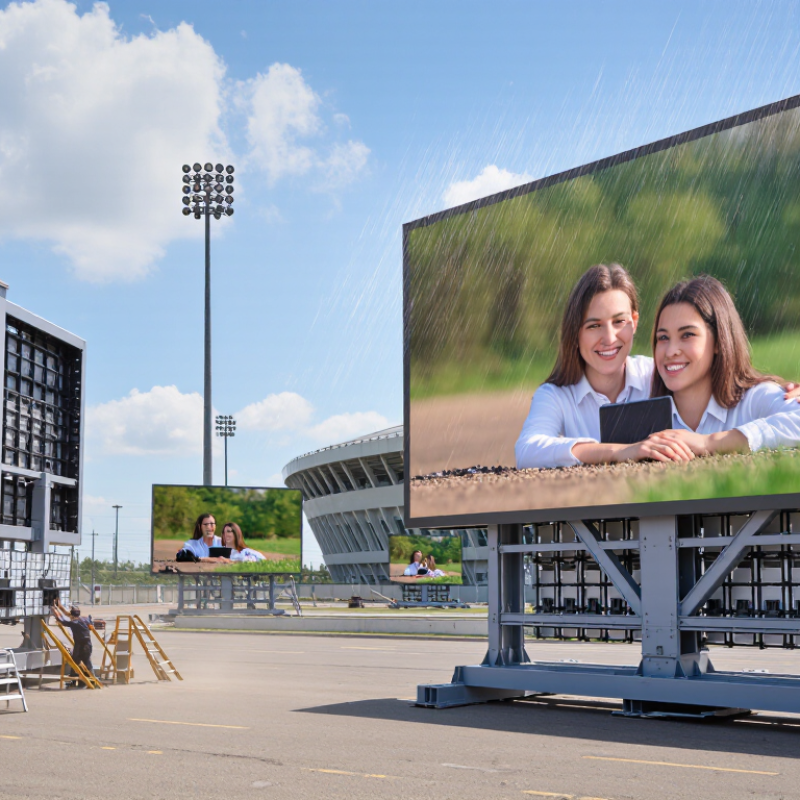
Outdoor DIP LED Displays: RGB Package Design, Pixel Pitch, and Viewing Distance
What Are the Top 10 Outdoor DIP LED Display Manufacturers?
Outdoor DIP LED Displays: RGB Package Design, Pixel Pitch, and Viewing Distance
Outdoor DIP displays use separate red, green, and blue LED packages to create full-color images. This RGB arrangement can support strong brightness, which helps when sunlight washes across a roadside screen. The larger packages are also easier to inspect during maintenance. However, color consistency depends on careful binning and module calibration. A bright panel is not automatically a clear one.
Pixel pitch—the distance between neighboring pixels—shapes how close viewers can stand before individual dots become distracting. A 10 mm pitch may suit a large sign viewed from several dozen meters, while a tighter pitch can improve detail at closer range. Treat that as a starting point, not a guarantee. Content, screen size, and viewing angle all matter. Small details matter.
Tips: Match pitch to the nearest regular viewing position, not just the farthest. Check sample text and faces outdoors, under daylight and at dusk. Ask how brightness is measured and how RGB modules are calibrated. A specification sheet can look precise; real viewing conditions are messier. I would leave room for that uncertainty when comparing manufacturers.
Outdoor DIP LED Displays: Pixel Pitch and Approximate Viewing Distance
A practical rule of thumb estimates the minimum comfortable viewing distance in meters as roughly equal to pixel pitch in millimeters. Actual viewing distance depends on content, installation, and viewing conditions.
Illustrative technical guidance only; values are not manufacturer-specific ratings.
Outdoor Performance Benchmarks: 5,000–10,000 Nits and IP65 Protection
Outdoor DIP LED displays are often specified at 5,000–10,000 nits, but the right level depends on sunlight, viewing distance, and screen orientation. A south-facing roadside sign may need more headroom than a shaded venue display. Higher brightness can improve daytime visibility, yet it also increases power use and heat. Check brightness under stated test conditions, not just a headline figure.
IP65 is a useful baseline for exposed installations. Under IEC 60529, the first digit means dust-tight protection; the second indicates resistance to water jets. It does not mean the cabinet can be submerged. Seals, cable entries, and service-door gaskets matter just as much as the rating. Ask manufacturers for test documentation covering the complete assembled cabinet, not only individual components. Small detail. Big difference.
For comparison, request measured brightness, power consumption, and temperature data at the same operating settings. A display rated at 8,000 nits may perform differently after hours in direct sun, especially if ventilation is limited. Look for thermal test results and a clear maintenance plan. One limitation remains: specifications do not fully predict performance at a particular site. Dust, glare, and installation angle can change what viewers actually see.
How to Assess Manufacturers: Refresh Rate, Reliability, Certifications, and Support
When comparing outdoor DIP LED display manufacturers, treat refresh rate as a measured condition, not a headline number. Ask for test results at the intended brightness, scan mode, and grayscale levels. A quoted 3,840 Hz may still produce camera banding under certain shutter settings. Test it live. Also request brightness and color-uniformity readings across the cabinet, not just one central module.
Reliability claims need evidence from comparable operating conditions. Ask for temperature-cycle, vibration, and aging-test records, plus field failure data and the method used to calculate MTBF. IEC 60529 defines IP65 as dust-tight protection and resistance to water jets; it does not mean a display can be submerged. The seal matters. Inspect cabinet joints, cable entries, and drainage after installation. Grand View Research’s LED Display Market Size report estimated the global market at about US$7.53 billion in 2023, but market growth alone says nothing about any factory’s quality.
Check whether certificates identify the exact product and configuration being quoted. Request traceable test reports, certificate numbers, and issuing-lab details. Support is equally concrete: confirm spare-module availability, response hours, remote diagnostics, and who handles on-site repairs. Ask for a written service plan. One small weakness: warranty length can look reassuring while exclusions leave outdoor weather damage uncovered. Read the exclusions, then speak with a customer running a similar display in similar conditions.
Top 10 Outdoor DIP LED Display Manufacturers: Products and Market Strengths
Outdoor DIP LED manufacturers typically offer full-color displays built with through-hole red, green, and blue lamps. Their products serve roadside signs, stadium perimeters, transport hubs, and large public screens. Wide pixel pitches suit distant viewing, while robust cabinets protect modules from rain, dust, and vibration. Check the actual enclosure rating and operating-temperature range; “outdoor-ready” alone is not a specification.
Market strength often comes from manufacturing consistency, customization, and dependable maintenance support. A capable supplier can match cabinet dimensions to a site, maintain color uniformity across modules, and provide practical access for repairs. High brightness helps in direct sunlight. Stable refresh performance matters when cameras record the screen. Small details count.
A comparison of ten manufacturers should examine product range, quality controls, delivery capacity, and regional service—not just advertised brightness. Ask for test reports and inspect a working sample under daylight and evening conditions. A ranking can still miss differences between batches. Not always. Confirm spare-module availability and warranty terms before choosing; those details affect long-term operating costs.
Comparing Suppliers: Power Use, Cabinet Design, Warranty, and Project Fit
When comparing outdoor DIP LED display suppliers, request measured average power, not only peak wattage. Ask for a sample test using your intended brightness, content, and operating hours. The U.S. Department of Energy’s 2022 Solid-State Lighting R&D Opportunities report discusses commercial LED package efficacy around 150 lumens per watt. That figure describes LED packages, not a complete display; controller losses, drive settings, and cooling change real cabinet consumption. Ask for proof. A supplier that cannot provide test conditions leaves a costly gap.
Cabinet design affects more than appearance. Check drainage paths, corrosion-resistant materials, service access, and how modules are replaced from the front or rear. For a roadside screen, wind loading and maintenance access matter; for a stadium, viewing distance and wide-angle visibility may matter more. Compare warranty terms line by line: coverage period, brightness degradation limits, labor, shipping, and response time. A long warranty can still exclude the parts most likely to fail. I would still verify this carefully. Request references for projects in a similar climate, then confirm spare-module availability and repair procedures. The best supplier is not automatically the one with the lowest quote; fit depends on site conditions, energy budget, and who will maintain the display.